Neil Vint Bursary Fund
Neil Vint Bursary News
I am delighted to have been awarded the 2026 Neil Vint Bursary for alumni of Chetham’s School of Music, which funds me to research the relationship between music and dance. After studying the violin at Chetham’s as a young teenager, before then turning my interest towards dance and theatre, I have been interested in the intersection between dance and music throughout my emerging career as a choreographer. Orchestras such as the Aurora Orchestra and Paraorchestra are leading the way in terms of ‘Orchestral Theatre’, multidisciplinary orchestral performances incorporating dance and story, which re-frames classical and contemporary music with fresh perspectives. The fund will allow me to dedicate time exploring this area, and the possibilities that emerge creatively when connecting dancers with classical musicians on stage. I will document the research through a series of blog posts, through film and, when the time is right, hold workshops so that what is discovered through the project can be added to and built upon by other musicians, dancers and theatre makers. I’m particularly interested in learning about the needs of young musicians and dancers in order to be equipped with the skills to perform and develop ‘Orchestral Theatre’ and how education institutions such as Chetham’s can prepare students for the increasingly multi-disciplinary work that is occurring.
With the bursary’s help, I will conduct practical research between dancers and musicians, which will result in a mini creative process to explore new ideas and also facilitate a general workshop where professional musicians and dancers can connect and network to develop collaborative practices.
I am incredibly grateful to be supported by Mrs Vint and the staff at Chetham’s School of Music as I take this next step. My place at Chetham’s was heavily subsidised by the government's music and dance scheme, as was my initial dance training with the Centre of Advanced Training in Exeter. This funding allows me to continue my practice in this early stage of my career as I develop and question the tools that a conservatoire education in dance and music has given me.
You can keep up to date with my music and dance research here: www.jonnyhibbs.uk/blog
If you are interested in this topic (or perhaps already an expert), please do say hello!
More on Orchestral Theatre:
Jane Mitchell is the artistic director of Aurora Orchestra and ‘feels passionately about finding new ways to make orchestral music speak to more people.’ Mitchell’s vision and the programming of Aurora Orchestra has led to this surge of ‘Orchestral Theatre’, which often has orchestras learn complex scores by heart and are performed in collaboration with other disciplines. Aurora’s ‘Carnival’, which was co-directed by Scott Graham of Frantic Assembly, transformed the concert through physical theatre into a trip through a Paris museum in 1900 and something. The musicians moved with their music, telling stories through their bodies as they played.
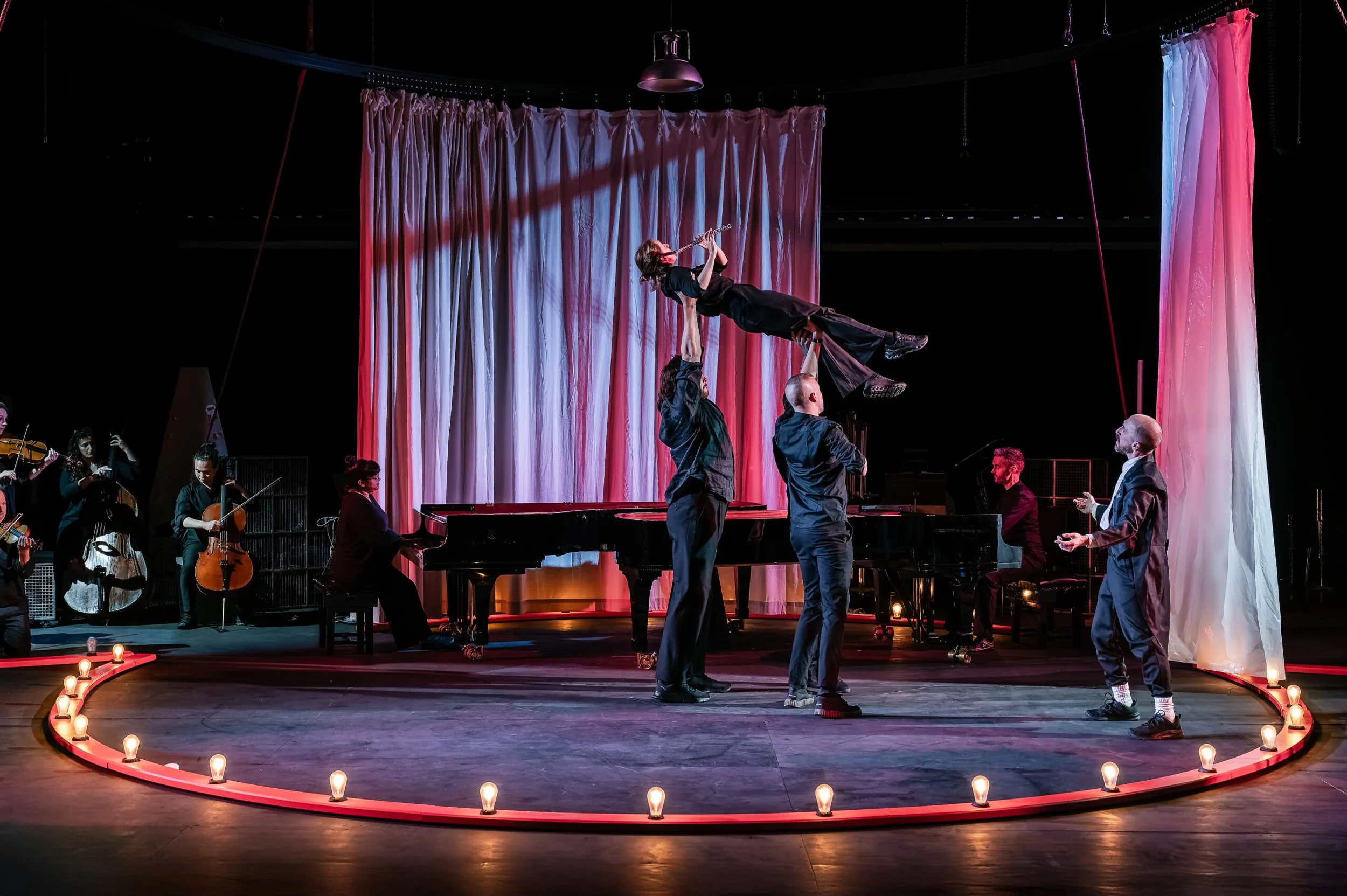
Aurora Orchestra - Carnival
Paraorchestra, led by Charles Hazlewood, is an orchestra of disabled and non-disabled musicians, united by a desire to ‘meld genres, re-imagine form and explore boundaries’. The orchestra continues to develop its collaborations with dancers and choreographers as they, too, explore the form (or perhaps attempt to resist all ‘form’ entirely) of orchestral theatre. With choreographer, Tom Jackson Greaves, paraorchestra created The Virtuous Circle, a riotous performance of orchestral work that used dance to fuel a vivid performance of Mozart’s 40th symphony, with abstractions composed by Oliver Vibrans.
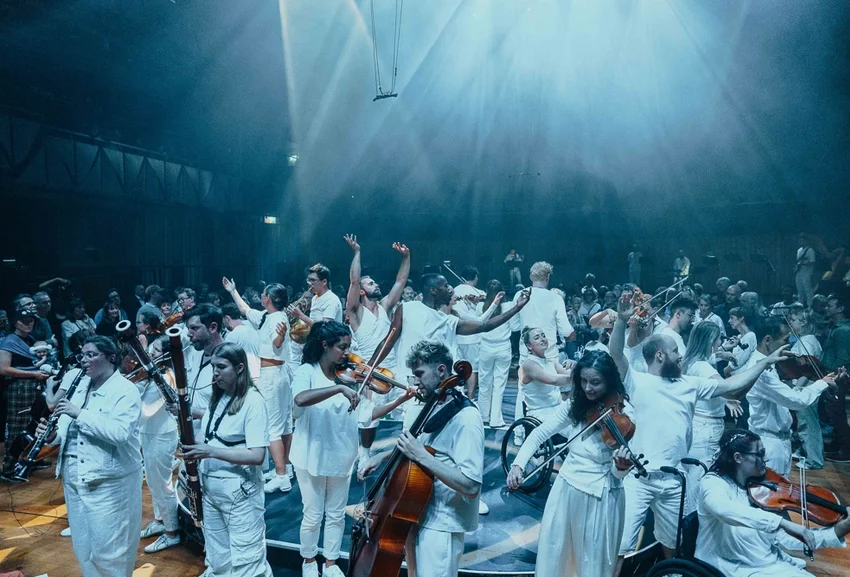
Paraorchestra - Virtuous Circle
Taking these two companies and their programming as case studies, I will continue to explore how dance, music and theatre is connected. Particularly, the dynamic qualities that lurk in dance and music and how best to bring them to the surface in performance.
